September is Suicide Awareness Month, and it feels important to talk about mental health in a way that is real.
Not just statistics.
Not just awareness posts.
But the reality of what supporting a child or young person through poor mental health can actually look like behind the scenes.
As a mum, I support two neurodivergent children with very different needs.
My five-year-old autistic son needs support around communication, safety, sensory needs, routines and accessing the world around him.
My teenage son is also autistic, but his needs are completely different.
His support has involved mental health, anxiety, emotional wellbeing and helping him navigate the pressures of being a teenager while also trying to understand himself.
It has reminded me that autism does not look one way.
And neither does support.
The Side of Mental Health Support People Do Not Always See
When people talk about mental health services, they often focus on the appointment itself.
But as a parent, there is so much that happens around that appointment.
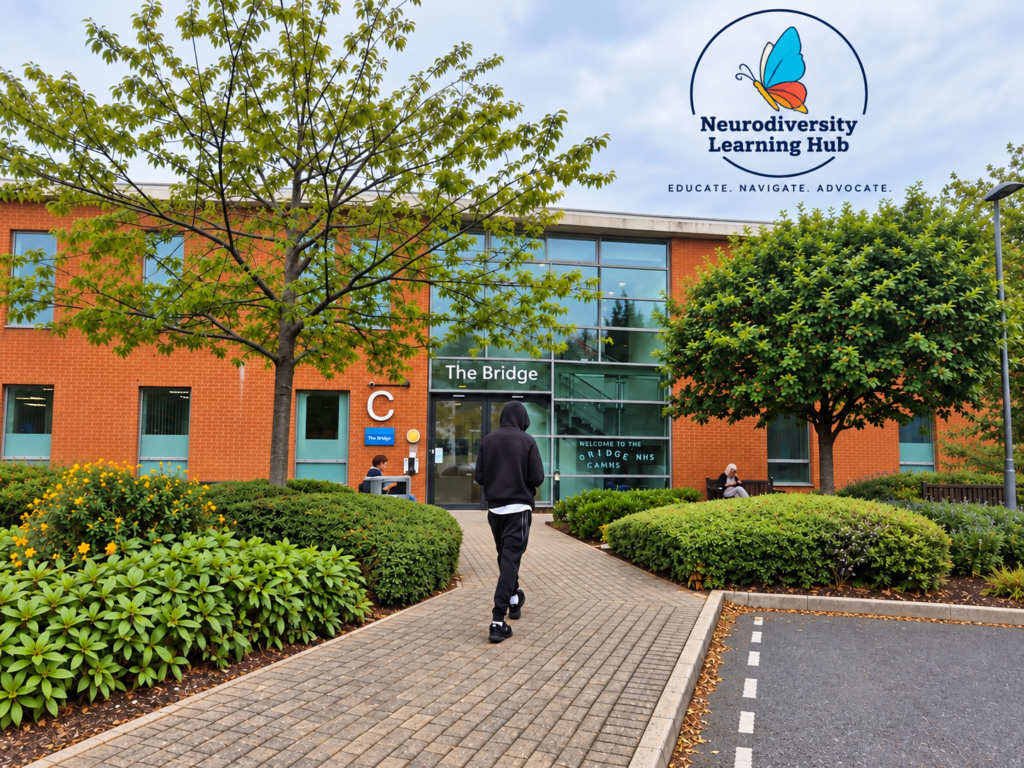
The picking up.
The driving.
The waiting.
The sitting in the car.
The rearranging of everything else around that one hour.
The hoping they will go in.
The wondering what kind of mood they will come out in.
The quiet drive home.
Sometimes the conversations afterwards.
Sometimes no conversation at all.
There is a lot of invisible parenting that happens around mental health support.
You are trying to be present without pushing too hard.
You are watching for changes.
You are trying to give space while also making sure your child knows you are there.
And often, you are carrying your own worry quietly in the background.
Our Experience With CAMHS Emerge 16–17
I also want to acknowledge something positive.
Our experience with CAMHS Emerge 16–17 has been incredibly supportive.
Mental health services are often spoken about negatively, and I completely understand why many families feel frustrated by long waits, thresholds and difficulties accessing help.
But I also think it is important to recognise good support when families receive it.
With my own teenage son, the team have been compassionate, consistent and understanding.
They have taken the time to get to know him as an individual rather than simply looking at a diagnosis or a set of symptoms.
They have supported him without making him feel judged.
And as his mum, I have felt that there are professionals around him who genuinely care about his wellbeing.
I do not want to share the personal details of his journey because that belongs to him.
But I can say that having the right professionals involved has made a difference.
Sometimes, knowing that somebody else is helping to hold part of the weight matters more than people realise.
Autism and Mental Health Can Intersect
One thing I have learned is how important it is not to separate neurodiversity and mental health completely.
Autistic young people can experience anxiety, depression, burnout, social isolation, low self-esteem and difficulties understanding or communicating how they are feeling.
Some may mask so well that people around them do not realise how much they are struggling.
A child or teenager can appear to be coping and still be finding life incredibly difficult internally.
That is why we need to look beyond behaviour.
Withdrawal can be communication.
Anger can be communication.
Avoidance can be communication.
Changes in sleep, eating, friendships, education or motivation can all tell us something.
Sometimes young people cannot find the words to say:
“I am not okay.”
Adults around them need to notice.
Two Autistic Children, Two Completely Different Needs
Having two autistic children has probably taught me more about neurodiversity than any textbook ever could.
They share a diagnosis.
But they are not the same.
The support my five-year-old needs would not meet the needs of my teenager.
And the mental health support my teenager needs would not necessarily be relevant to my younger child.
That sounds obvious, but sometimes systems still treat diagnoses as though they come with a standard package of needs.
They do not.
Behind every diagnosis is an individual person.
Their age, personality, communication, experiences, environment, sensory profile and emotional wellbeing all matter.
Support has to start with the person, not the label.
The Parent Behind the Scenes
There is another part of this conversation that often gets overlooked.
The parent.
When your child is struggling with their mental health, it is difficult to simply switch off.
You can be making dinner while thinking about them.
Driving another child to school while worrying about them.
Answering emails, working, attending meetings and carrying on with everyday life while part of your mind is constantly checking:
Are they okay?
Have I missed something?
Should I ask?
Should I give them space?
Do I need to do more?
It can be exhausting.
But sometimes our job is not to have all the answers.
Sometimes it is simply to keep showing up.
To drive them to the appointment.
To sit in the waiting room.
To be there when they come out.
To listen if they want to talk.
And to sit quietly beside them if they do not.
Suicide Awareness Has to Be More Than a Month
Suicide awareness should never be reduced to one month or one social media post.
We need to create environments where young people feel able to say they are struggling before they reach crisis point.
We need accessible mental health services.
We need professionals who understand neurodiversity.
We need schools and colleges to recognise changes in behaviour and attendance as possible signs of distress.
And we need to stop assuming that because a young person looks okay, they are okay.
Most importantly, young people need to know that asking for help is not weakness.
Sometimes asking for help is the bravest thing they can do.
A Thank You to the People Who Support Our Young People
I am deeply grateful for the professionals who have supported my son.
The appointments may only occupy a small part of the week, but the impact of compassionate, consistent support can reach much further.
To the professionals who take the time to listen, who do not judge, who build trust slowly and who recognise the person behind the diagnosis — thank you.
Families remember that.
Young people remember that too.
The NLH View
At Neurodiversity Learning Hub, we believe mental health support must recognise the individual needs of neurodivergent children and young people.
Autism, ADHD and other forms of neurodivergence do not protect somebody from mental health difficulties.
Sometimes they can make navigating those difficulties even more complex.
Early support matters.
Listening matters.
Consistency matters.
And having the right person alongside a young person at the right time can make an enormous difference.
If you are worried about a child or young person’s mental health, please do not wait until things reach crisis point before seeking support.
And if a young person tells you they are struggling, believe them.
Sometimes the most important thing we can say is:
“I’m here. You don’t have to carry this alone.”
Share Your Story
Have you supported a neurodivergent child or young person through mental health difficulties?
At Neurodiversity Learning Hub, we believe parent and carer experiences deserve to be heard.
Sharing those experiences can help reduce stigma, increase understanding and remind other families that they are not alone.
To share your story, contact info@nlhadvocacy.co.uk.
If you or someone you know is in immediate danger or at risk of suicide, call 999 or go to A&E. In the UK and Ireland, Samaritans can also be contacted free on 116 123, 24 hours a day.
Discover more from Neurodiversity Learning Hub
Subscribe to get the latest posts sent to your email.